





















Fuel Price Hike Set to Deepen South Africa’s Cost-of-Living Crisis
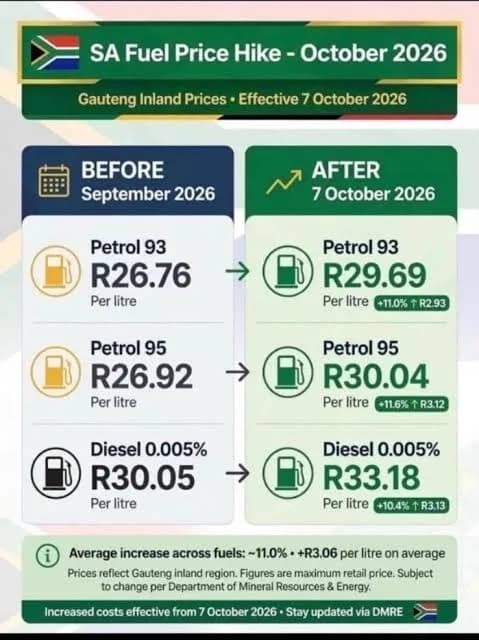
South Africans are bracing for another major blow to household finances as petrol and diesel prices rise sharply from Wednesday, 7 October 2026.
The latest increase will push fuel prices to record levels, with the official adjustment adding R3.12 per litre to 93-grade petrol, R3.33 to 95-grade petrol and R3.24 to 0.005% diesel. The increases are being driven largely by higher international crude oil and petroleum product prices, as well as global supply disruptions.
For motorists in Gauteng and other inland areas, the increase means 95-grade petrol will move above R30 per litre, adding further pressure to already stretched household budgets.
Working class households under greater pressure
For South Africa's working class, the latest increase is about much more than the cost of filling up a vehicle. Fuel is deeply connected to almost every part of the economy.
Workers who rely on private vehicles to travel to work will have to spend more on their daily commute, while those dependent on taxis and buses could eventually face higher fares as transport operators absorb increased fuel costs.
Labour federation Cosatu has warned that workers can spend as much as 30% of their wages on transport, meaning another significant fuel increase could quickly eat into money that would otherwise go towards food, electricity, school expenses and other household necessities.
Statistics South Africa has already shown how fuel increases can ripple through the economy. In June 2026, transport was the biggest contributor to monthly and annual inflation, while fuel prices had risen sharply over the preceding year.
Food prices could feel the knock-on effect
The impact will not stop at the petrol station.
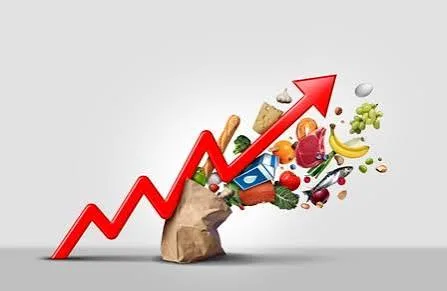
A large proportion of goods sold in South African shops are transported by road. Farmers need diesel for agricultural machinery, while trucks require diesel to move food from farms and factories to distribution centres and ultimately to supermarkets and smaller retailers.
The Road Freight Association has estimated that fuel accounts for roughly 35% to 55% of road-freight operating costs, meaning sustained increases in diesel can place significant pressure on the cost of transporting goods. More than 80% of land-based freight in South Africa is transported by road.
This creates a worrying possibility for consumers: higher transportation and distribution costs could eventually be reflected in the prices of food and other basic goods.
That does not mean every food item will immediately become more expensive, and some businesses may absorb part of the additional cost. However, continued fuel-price increases create pressure throughout the supply chain.
The unemployed face an even harsher reality
For unemployed South Africans, the situation is particularly concerning.
A person without a salary cannot simply absorb another increase in transport, food and household costs. Many unemployed people already depend on social grants, family members or informal work to survive. When the price of commuting rises and basic goods become more expensive, there is very little room left in already limited household budgets.
The September household affordability figures highlighted just how tight the situation already is. The Pietermaritzburg Economic Justice and Dignity Group estimated that a basic nutritious food basket for a family of seven cost R6,655.29, while a worker earning the national minimum wage was left with only about R1,799.19 after transport and electricity for food and other household expenses.
For unemployed households, the financial pressure can be even more severe.
A warning for the months ahead
The October fuel increase therefore raises broader concerns about South Africa's cost-of-living crisis.
When transport becomes more expensive, households have less money available for groceries. When the cost of moving goods rises, businesses face pressure to increase prices or absorb smaller profit margins. When food and transport take up a larger share of household income, families are forced to cut back on other necessities.
The South African Reserve Bank has also warned that inflation is expected to remain elevated into 2027, with fuel and services among the factors driving the pressure.
For millions of South Africans already struggling to make ends meet, the latest fuel hike is not simply another number displayed on a petrol station sign. It is another squeeze on household survival.
As October progresses, consumers will be watching closely to see whether the higher cost of fuel begins filtering through to taxi fares, public transport, groceries, agricultural products and other essential goods.
For the working class and unemployed, the fear is simple: if incomes remain stagnant while the cost of getting to work and putting food on the table continues to rise, there will be increasingly less money left to live on.